Dear Visitor | | IOW's NEWSLETTER #14
July 2026
Thank you for subscribing to IOW's Newsletter!
By subscribing to IOW’s Newsletter, you will be updated about the latest keywords uploaded, and provided news about the project in general and the activities of IOW's collective. The Newsletter will also disseminate Calls for conferences and publications connected to issue of Othering.
And you can become an active participant to IOW's dictionary, by proposing and discussing words that are used to (re)produce different forms of Otherness, and/or suggesting keywords that you would like to be discussed! You can visit regularly www.iowdictionary.org to find further info on keywords and on how to join the project. |
|
|---|
New entries
- boiler by Class 2A, G1. In their analysis, students reflect on what defines the normative ideal of female body for women in general and girls in particular, discussing how beauty canons are imposed on female bodies since a young age, and how female bodies who do not conform to these normative canons are targeted by derogatory words – such as ‘boiler’ and ‘golem’, which is here jointly analyzed –, as well as by processes of exclusion and discrimination both in-person and online.
- chelha by Ramdane Touati. This entry examines a term used in Tamazight (Berber), Arabic, and French to refer to languages and ethnic groups. In most contexts, aside from southern Morocco, the term signifies alterity—particularly concerning language—and often carries a pejorative connotation. Chelha specifically refers to a subaltern language that lacks recognition and legitimacy from others.
- hogra by Filippo Torre. Hogra (حقرة) is a word difficult to translate, generally meaning ‘humiliation’ or ‘oppression’ in the Arabic dialects of the Maghreb. It has become a strongly politicized term, an expression with a fluctuating meaning that immediately conveys a feeling of social and economic injustice shared by large segments of the Maghreb population. Today, the maḥgūr (the ‘humiliated’) is a social category with which thousands of oppressed youth on the southern shore of the Mediterranean identify, from the working classes to the middle classes.
n-word by Class 2A, G2. How is the n-word perceived by Italian teenagers? How is it used within their peer interactions? From its colonial legacy to the contemporary reappropriations in hip hop tracks, students analyze how this derogatory word has travelled across violent discriminations and oppressions to acquire different significations according to the diverse contexts, speakers, and recipients. The students will finally focus on its present meanings in the Italian youth context, also presenting examples of reappropriations and subversions.
Forthcoming entry
- identities in postcolonial settings by Lamprini Chartofylaka & Maurizio Alì. Postcolonial identities are inherently multiple, hybrid, and contested, shaped by centuries of (post)colonial violence, cultural erasure, and administrative assimilation. Within these power dynamics, local communities continuously assert, reclaim, and re-signify their identities on their own terms. The authors will provide examples of how Otherness is challenged and transformed into collective cultural affirmation through traditional and contemporary (board) games in a very peculiar postcolonial context: French Antilles.
|
|
|
|---|
IOWers at CONFERENCES, SEMINARS, WEBINARS
May-July 2026 - May 4: Department of European, Euroasian, and American Languages and Cultures, University of Catania, Italy. Paola Giorgis conducted an online webinar on IOW dictionary with the students of the course ‘Language and Translation’ held by Francesca Vigo and Salvatore Ciancitto. She presented IOW as a critical and educational resource, also offering examples on how to choose and write an entry.
May 20: Centre of Discourse Studies (online). Paola Giorgis and Bilyana Todorova presented IOW dictionary as a resource to challenge polarized and discriminatory discourses through participatory strategies of resistance, reappropriations, and resignifications. After the presentation, the Chair gave this definition of IOW dictionary: “a grass-root counter dictionary of resistance”.
May 21: UCL (University College London), Institute of Education (IOE), International Centre for Intercultural Studies, London, UK. Series of seminars organized by BAAL (British Association of Applied Linguistics), SIG (Special Interest Group) in Intercultural Communication. Paola Giorgis presented IOW dictionary showing how it promotes creativity as an ethical/political praxis able to problematize dominant knowledge structures and offer new methods for language teaching and learning.
May 28: (online) within the workshops organised by UAL (University of the Arts) and the Feminist Review Collective, Victoria Odeniyi presented “The occluded practice of peer review” engaging the audience in reflections and discussions about the overt and covert mechanisms of peer-reviewing, and how to navigate them.
July 8-10: English Philology Department, University of Valladolid, Valladolid, Spain. CADAAD (Critical Approaches to Discourses Analysis Across Disciplines) Conference. Paola Giorgis presented IOW dictionary as a free and participatory online resource to counter polarizing discourses, illustrating IOW's ethics and structure, and offering examples of subversion.
|
|
|
|---|
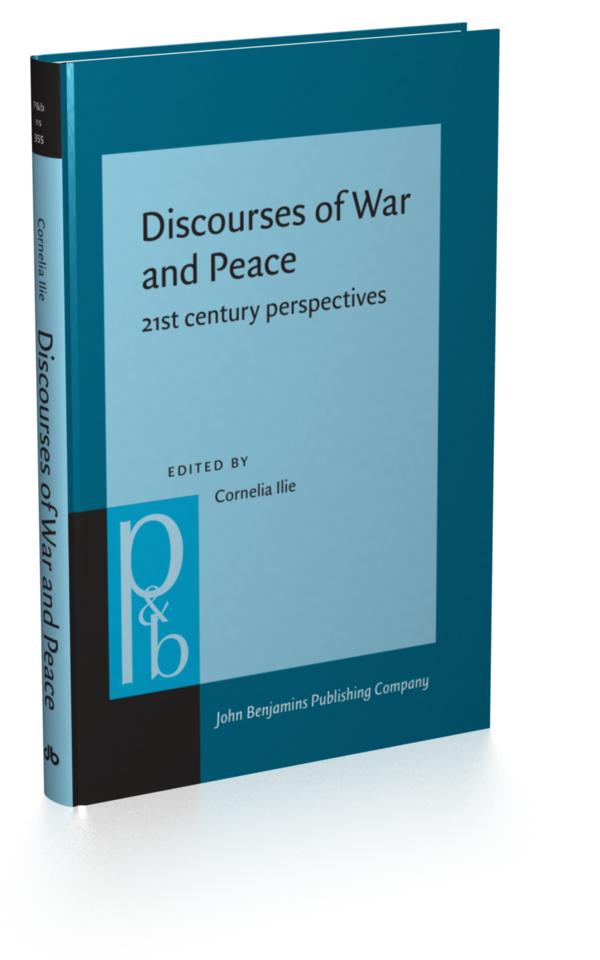
Ilie, C. (2026). (ed.) Discourses of War and Peace: 21st Century Perspectives. John Benjamins. https://benjamins.com/catalog/pbns.355?srsltid=AfmBOoqJ7bvSGIjvLzO52n3df9We2AFuyveYWtxGRS_jFnTOVu2zIEZl
Unfortunately more timely than ever, the volume explores of the overall scope, implications and consequences of shifting discourses of war, peace and neutrality across time and space from the Russo-Japanese war (1904–1905) to Russia’s war against Ukraine (2022-present), also in relation to conflict-ridden geopolitical environments characterised by power struggles, political polarizations, divergent goal settings and ideological confrontations.
|
|
|---|
Alexander von Humboldt Foundation 18th call for proposals of the Philipp Schwartz Initiative
Universities, universities of applied sciences and other research institutions in Germany can apply for funding from the Alexander von Humboldt Foundation to support threatened researchers.
Scholars from non-EU countries exposed to significant and acute individual risks can be nominated.
Please note that scholars must be nominated by institutions and cannot apply directly.
The application deadline is 21 August 2026 and the selection results are expected to be available by the end of November 2026. Fellowships can be taken up from 1 January 2027.
Further info at:
For any questions, please contact: the programme director, Ms Cornelia Hörtner, the senior programme coordinator Ms Katja Machacsek, or the programme officers, Ms Judith Dömer-Warneke, Ms Sandra Grziwa, Ms Mashal Habib, Ms Bianca Schneemayer, Ms Mona Simon, and Ms Lena Vos at schwartz-initiative@avh.de.
|
|
|---|
CALL FOR PAPERS - CONFERENCES |
|
|---|
University of Naples Federico II, Naples, Italy
Performing Identity: Semiotic Representation(s) and the Making of Meaning
Dates: 3-4 December 2026
Deadline: 15 July 2026
The conference invites contributions that explore how identities are constructed, performed, negotiated and reimagined in and through English across a wide range of contexts and modalities. Moving from the idea that identity is not something we simply have, but something we do, the conference foregrounds the performative, processual and semiotic nature of identity, with particular attention to discourse, interaction, multimodality, digital mediation, embodiment, power relations and ecological concerns.
Abstracts should not exceed 300 words and should include a maximum of 5 references in APA style.
Proposals should be sent to:
fcavalie@unina.it
aureliana.natale@unina.it
fabio.cangero@unina.it
performid2026@gmail.com
|
|
|---|
University of Opole, Collegium Maius, Opole, Polonia
DN35: Mapping and Countering Authoritarian Discourses
Dates: 25-26 February 2027
Deadline: 30 September 2026
The Conference wants to reflect on (neo)authoritarianism today, its role in public discourse, and its impact on contemporary politics, also mapping the discusive construction of the (neo)authoritarian appeal across the Global North and South, and the ways in which they can be counteracted.
A wide range of methodologies and approaches to researching these issues, including critical political, psychological, and post-structuralist discourse analysis, corpus linguistics, and rhetorical analysis are welcome.
Full info at: https://discourseanalysis.net/DN35
|
|
|---|
Philipps-Universität Marburg, Marburg, Germany
DiscourseNet 2027 Conference: Discursive Imaginaries of Change - Heterotopias, PowerKnowledge, and the "Great Transformation"
Dates: 19-21 July 2027
Deadline: 31 October 2026
The DNC 2027 congress invites scholars to step beyond "problem talk" and to ask instead: what discursive fissures, counter-imaginaries, and heterotopian spaces are emerging? What futures are already being articulated — and by whom?
DNC 2027 welcomes submissions in the following formats:
Single papers, Symposia, Research Workshops
UnConferencing
We will organise a participatory and cocreational unconferencing format at the second afternoon of the congress. Everybody is invited to suggest topics for unconferencing sessions.
Full info at: https://discourseanalysis.net/DNC2027
|
|
|---|
We are looking forward to hearing your comments and suggestions, as well as to welcoming your contributions! In the meanwhile, take care & stay tuned!
Paola Giorgis on behalf of IOW's Editorial Board
For further info, please write to: info@iowdictionary.org
| |
|
|---|
|
|